
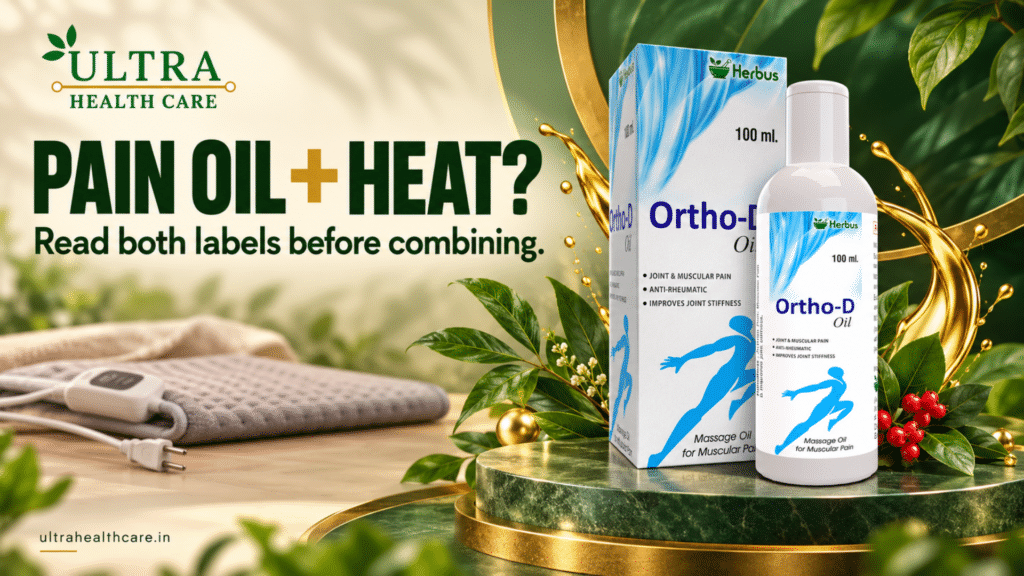
Pain-Relief Oil and a Heating Pad | What to Check Before Combining Them
Can you use a heating pad after applying pain-relief oil? Start with the exact product label and the heating-device instructions. Some topical pain medicines prohibit external heat; a warming sensation does not establish that the combination is safe. If either label is unclear, ask a pharmacist or qualified clinician before combining them.
If you use Ortho-D Ayurvedic Pain Relief Oil, check its own pack label alongside the device instructions. This guide explains what to check and what to ask a qualified professional; it does not establish a safe combination, temperature or waiting interval for Ortho-D Oil.
Pain-relief oil and a heating pad: why labels matter
A product’s name tells you little about how it should be combined with a device. “Massage oil”, “herbal” and “warming” are not interchangeable instructions. Even the difference between a pain-relief oil and a roll-on concerns the product format, not permission to add heat. A hot-water bottle, electric heating pad and heated wrap have their own warnings. The linked comparison includes heat-use suggestions; do not treat those as verified instructions for your exact product and device.
Make the question specific: name the topical product, identify the device and explain the area involved. “Can I add heat?” is less useful than showing a pharmacist the actual pack and device instructions together.
Considering Ortho-D Oil for your massage routine?
Explore the ingredients, pack options and product information, then check your own pack label before use. The listing does not confirm that adding a heating pad is safe.
What the evidence and safety guidance actually say
An example menthol-patch label published in the US National Library of Medicine’s DailyMed database says not to use that product with a heating pad, avoid local heat and avoid tight bandaging. It also warns about serious burns. [1] This is evidence of a real product-specific warning, not proof that every topical formulation has the same composition or risk.
The Institute for Safe Medication Practices’ consumer guidance also advises against applying heating pads, hot-water bottles or heat lamps over topical muscle-and-joint pain relievers. It highlights serious burns and other adverse effects as concerns. [2] This supports caution; it does not supply a tested protocol for combining an Ayurvedic oil with heat.
Neither source is a clinical trial of Ortho-D Oil. No product-specific combined-use safety study, validated heating temperature or waiting time was verified for this article. We therefore cannot turn general advice into a claim that this particular combination is safe.

Read the oil label and device instructions separately
For the topical product, check intended use, complete ingredients, warnings, application directions and any restrictions on heat or covering the area. Keep the batch and date information readable. Do not use a short website description as a substitute for the actual label.
For the device, check its intended body areas, settings, time limits and restrictions. A lower setting is not evidence that it can be combined with a medicine. If one set of instructions prohibits the combination, a more permissive description elsewhere does not cancel that warning.
Write down what is known and what is missing. For example, the oil may have directions for external application but no readable heat-device guidance. That gap is a reason to clarify, not a reason to choose your own waiting period.
When comparing products in the joint and muscle care range, check each formulation’s own directions. A category name or similar packaging does not establish identical ingredients or permission to add heat.
Traditional massage does not validate added heat
Oil massage has a long place in Ayurvedic practice. Our explainer on how Ayurvedic pain oils work discusses massage and warming or cooling sensations. Those sensations do not establish that an electric pad or hot-water bottle should be added over a finished formulation. The explainer’s warming routine is not a verified combined-use protocol for Ortho-D Oil; follow the actual label and clarify uncertainty with a qualified professional.
The Ortho-D website discusses massage and warming practices. This article does not interpret that wording as permission to use external heat over the applied product. Exact formulation details, the batch label and a qualified professional’s advice are needed to resolve uncertainty. Do not independently heat the bottle or improvise a preparation method from a general wellness article.
A recent injury changes the discussion
If the discomfort began after twisting an ankle, lifting something or falling, do not assume it is simply everyday stiffness. NHS sprain-and-strain guidance advises avoiding heat and massage during the first couple of days after such injuries to help avoid worsening swelling. [3] That is separate from a topical-medicine interaction warning.
The distinction matters: a person may need advice about the injury itself as well as the proposed product combination. This guide cannot diagnose the cause of pain or decide whether heat, massage or a topical product is appropriate.
Before trying a home-care routine after an injury, clarify what caused the pain and whether the proposed product or device is appropriate. Keep shopping decisions separate from the need for assessment.
A practical question list for a pharmacist or clinician
Bring the pack, device instructions and a short description of the problem. Say when symptoms started, whether an injury occurred and what has already been applied. Identify the exact formulation—for example, Ortho-D Oil or Ortho-D Plus Oil Roll-On—rather than saying only “pain oil”. Include other topical products used on the same area. Similar brand names do not establish identical ingredients or directions.
Ask four clear questions: Is this product appropriate for this situation? Does its label prohibit external heat? Does the device have relevant restrictions? What should I do if the directions do not answer my question? A recommendation for one family member should not automatically become advice for everybody in the household.
For pregnancy or breastfeeding, children, existing skin problems, reduced sensation or other medical conditions, seek advice about the exact product and device before use. This is not a blanket contraindication list for Ortho-D; its verified label and individual clinical circumstances must guide that decision.
If your pack is difficult to read, request a readable label and batch-specific directions from Ultra Healthcare. Share those details with your pharmacist or clinician when asking about external heat.
When to stop experimenting and seek care
Stop using a topical product if it causes a concerning reaction. Severe burning pain, swelling or blistering where it was applied warrants medical attention, as reflected in the example DailyMed label. [1] Do not try to improve the situation by adding more product or heat.
After an injury, seek prompt assessment for severe or worsening pain, major swelling, inability to use or bear weight on the affected area, deformity or numbness. NHS guidance lists these among reasons for urgent assessment. [3] Use local Indian medical services rather than copying UK service numbers from the source.
Frequently asked questions
How long should I wait after applying oil before using a heating pad?
No universal waiting interval was verified. Washing the area or waiting a guessed number of minutes is not a validated workaround. Ask about the exact formulation and follow its restrictions.
Is a hot-water bottle different from an electric pad?
They are different devices, but both supply external heat. Do not assume one avoids a topical product’s heat warning.
Can I wrap the area tightly instead?
Check the topical product’s warnings. Some labels prohibit tight bandaging. A support recommendation for an injury is not permission to cover an applied medicine tightly.

Key takeaways
Read both labels, separate injury advice from product-combination advice and do not invent a safe heat setting or waiting interval. Traditional use and a familiar warming feeling do not replace clear instructions. If the combination is uncertain, pause and get a specific answer.
Your next step: Keep the pack and device instructions together. Resolve any missing heat guidance before combining them; do not use a guessed waiting time or a lower heat setting as a workaround.
Looking for a roll-on format? Explore Ortho-D Plus Oil Roll-On product details and check its own ingredients and directions. A different applicator does not remove heat-related precautions.
References
[1] DailyMed: Icy Hot menthol patch label. Example product label, not Ortho-D instructions. Accessed 1 November 2026.
[2] ISMP Consumer Med Safety: Adverse Effects with Medicines Applied to the Skin. Accessed 1 November 2026.
[3] NHS: Sprains and strains. Page reviewed 23 April 2024; accessed 1 November 2026.