
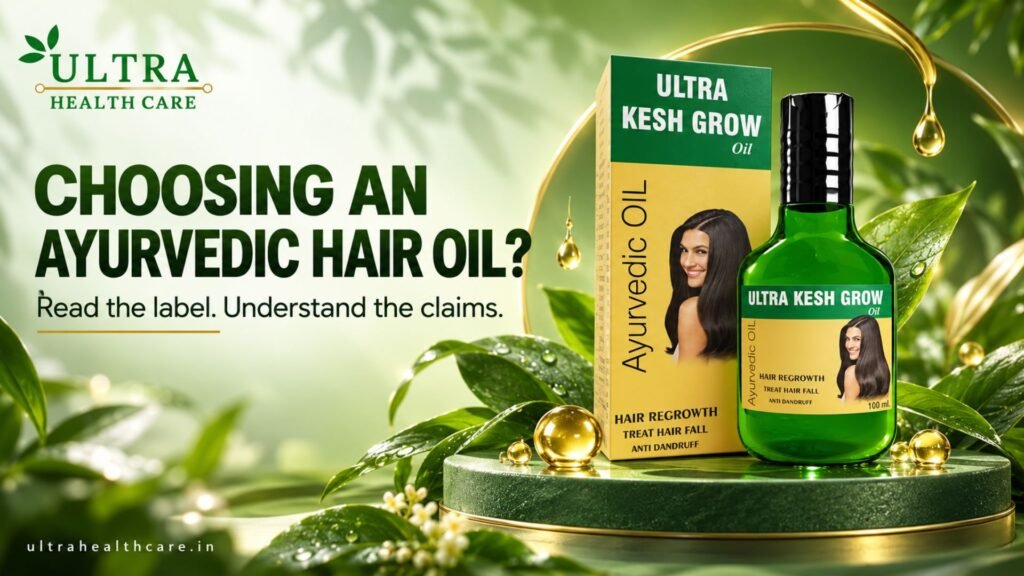
How to Choose an Ayurvedic Hair Oil | Labels, Evidence and Realistic Expectations
A hair-oil shelf can be confusing: one bottle highlights bhringraj, another promises strength, and a third puts growth in its name.
Before comparing those claims, decide what you actually want to buy. An optional step in a grooming routine is a different decision from treatment for a widening part or new bald patch.
This guide explains how to choose an Ayurvedic hair oil, read its label and ask better questions. It does not recommend an oil as treatment for hair loss, diagnose a scalp problem or establish that a particular formulation grows hair.
Start with your reason for buying
Write your goal in one sentence. For example: “I want to understand whether this product fits my usual pre-wash routine.” Compare that with “My hair is becoming visibly thinner.”
The second concern deserves assessment rather than an endless search for a stronger oil. Keep the comparison manageable when comparing hair-care products. Note the product name, pack size, listed ingredients, intended use and instructions.
If the information is incomplete, leave the field blank and ask the manufacturer. An empty field is more useful than a confident guess.
Is Ultra Kesh Grow Oil right for your routine?
Compare the listed ingredients, pack size and precautions before you choose.
For conditioning care. Not a treatment for hair loss.
Hair feel, breakage and regrowth are different outcomes
A product can be discussed in terms of appearance or manageability without establishing a change in the number of hairs growing from the scalp.
Likewise, a claim about stronger-looking lengths should not be silently converted into a claim about treating a medical cause of thinning.
When an advertisement says “works”, ask what was measured: consumer impressions, combing performance, breakage, shedding or a clinical measure of growth?
Those outcomes answer different questions. A photograph or a satisfied review cannot substitute for a clear study description.
What established hair-care guidance supports
The American Academy of Dermatology advises matching products to hair type, conditioning after washing and detangling gently.
These recommendations concern an overall routine; they are not evidence that every oil, herb or blend is suitable for every person. [1]
For people already experiencing hair loss, AAD recommends finding the cause with a dermatologist and handling fragile hair gently. Its advice also cautions against hot-oil treatments for fragile hair. [2]
Do not infer that heating an oil makes it more effective. The practical implication is to judge a product within your routine, rather than expecting it to compensate for repeated heat styling, forceful detangling or an undiagnosed scalp condition.
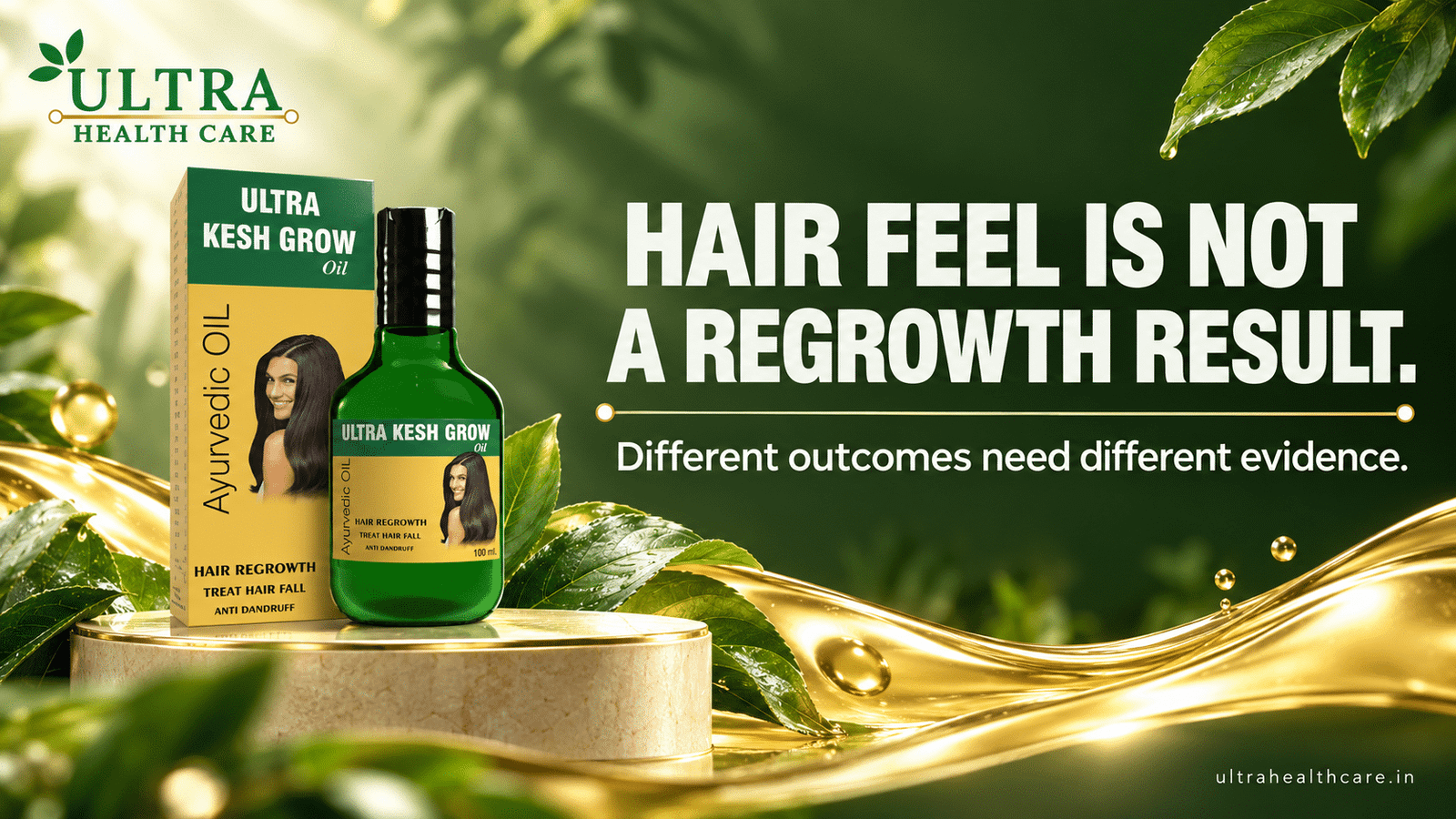
Traditional Ayurvedic use | useful context, limited proof
Traditional hair-oiling practices help explain why certain ingredients are familiar in Indian homes.
That history can be relevant to a formulation’s background. It does not by itself establish the finished product’s effectiveness for a particular type of hair loss.
NCCIH describes limits in the clinical evidence available for many Ayurvedic approaches. [3] Its broad overview is not a trial of Ultra Healthcare hair oil. Nor does research on an isolated ingredient automatically transfer to a different concentration, extraction method, carrier oil or finished blend.
Ask whether a claimed result comes from tradition, laboratory research, an ingredient study or a controlled human study of the exact product. If the answer is unclear, do not upgrade it into a stronger claim yourself.
A five-field label checklist
1. Identity and intended use
Confirm the exact product and whether it is intended for external use. Do not infer its regulatory category from a marketing name. If a medicinal or cosmetic classification matters to your question, obtain the actual label or documentation.
2. Full formulation information
Read beyond the headline botanicals. Ask about the complete ingredient list, carrier oils and any fragrance information relevant to your needs. A familiar plant name on the front does not describe everything inside.
3. Directions and warnings
Check application instructions, contact time if specified and precautions. This guide does not invent a universal amount, weekly frequency or overnight-use instruction. More frequent use should not be treated as proof of a better result. If your routine also includes a dandruff treatment, its anti-dandruff shampoo frequency depends on the active ingredient and pack directions, rather than your oiling schedule.
4. Batch and dates
Keep batch details, dates and the original label readable. Take a clear photograph when you open the pack. This helps identify the product in a later enquiry; it does not extend its labelled life.
5. Traceable support
Use the manufacturer’s official product support for a label or order question. Ask a precise question such as “Where can I find the complete ingredients for this batch?” Keep personal medical decisions with a qualified clinician.

Build a comparison that avoids guesswork
Imagine two bottles with different pack sizes. One has clear directions; the other has a longer list of attractive claims but little practical information.
Before deciding on price or reputation, collect the same basic fields for both. A missing instruction is a question to resolve, not a reason to borrow directions from another product.
Keep observations separate from conclusions. You can record that a product feels heavy or is difficult to wash out without concluding that it damages follicles.
You can also enjoy a grooming ritual without presenting it as treatment. Clear language protects both your purchasing decision and the advice you share with others.
Safety and when to seek advice
Do not assume plant-based ingredients suit everyone. If a product causes discomfort or an unexpected reaction, stop using it and seek appropriate advice. Do not keep testing a suspected trigger simply to finish the bottle.
Sudden hair shedding, new patches of loss, progressive visible thinning or ongoing scalp symptoms should prompt professional assessment rather than repeated product switching.
For children, pregnancy, breastfeeding, diagnosed scalp conditions or use alongside prescribed treatments, ask a qualified professional about the specific product before introducing it.
Frequently asked questions
Does a product name containing “grow” prove regrowth?
No. Assess the exact claim and the evidence supporting it. This article has not verified product-specific clinical regrowth evidence.
Should everyone oil overnight?
This guide provides no universal overnight recommendation. Follow the actual pack and obtain advice if its instructions do not address your situation.
Are more herbs automatically better?
A longer ingredient list is not a ranking of suitability or clinical effectiveness. Read the complete formula and clarify the intended use.
Key takeaways
Choose the question before choosing the bottle. Distinguish grooming outcomes from treatment claims, compare the same label fields and keep realistic expectations.
A familiar Ayurvedic ingredient can be part of a product story without proving that the finished formulation treats hair loss.
References
[1] AAD: Tips for healthy hair. Accessed 31 October 2026.
[2] AAD: Hair loss: Tips for managing. Accessed 31 October 2026.
[3] NCCIH: Ayurvedic Medicine: In Depth. Accessed 31 October 2026.
Pingback: How Often Should You Use Anti-Dandruff Shampoo? A Guide by Ingredient - Ultra Healthcare