

Best Time to Drink Neem Karela Jamun Juice – Morning or Night?
According to the ICMR-INDIAB Study 2023, 101 million Indians are now living with diabetes – and a significant number of them reach for neem karela jamun juice every morning as part of their daily routine.
Most do it out of habit or family tradition. Very few know why the timing matters. And almost nobody knows that the right timing for them depends entirely on what they’re trying to achieve.
The answer is not as simple as “drink it in the morning.”
Whether your goal is blood sugar management, liver support, weight loss, or general immunity, the optimal window shifts and for people on diabetes medication, getting the timing wrong creates a real clinical risk that most articles ignore entirely.
This article gives you the mechanistic reasoning behind each timing window, a personalised framework based on your health goal, and the honest safety guidance that promotional content consistently leaves out.
Key Takeaways
Morning on an empty stomach is the optimal window for most users — but the biochemical reasons matter more than the rule itself.
Diabetic users on medication face a real hypoglycemia risk and must time this juice differently from general wellness users.
Neem, karela, and jamun each have distinct pharmacodynamic windows; the combination shifts but does not override individual ingredient logic.
Chrononutrition science gives morning a clear edge for glucose modulation — insulin sensitivity peaks in the early hours and declines through the day.
“Natural” does not mean “without risk.” Contraindications exist for pregnant women, people with G6PD deficiency, and those on insulin or sulfonylureas.
Why Timing Affects How Well These Compounds Work
The body’s metabolic state changes dramatically across the day. Insulin sensitivity – the body’s ability to respond efficiently to glucose – is highest in the morning and declines steadily through the afternoon and evening.
This pattern, documented extensively in chrononutrition research published in Diabetes Care and Obesity Reviews, means that glucose-modulating compounds do their most useful work when consumed during the morning metabolic window.
This is not a principle unique to neem karela jamun juice. It applies broadly to any intervention designed to regulate blood glucose.
Taking a pharmacologically active formulation at a time when your cellular machinery is most receptive to its mechanism is simply more efficient than taking it when those pathways are operating at reduced capacity.
Fresh Juice vs. Bottled Juice | Does It Change the Timing Logic?
The bioactive compounds that make this juice therapeutically relevant are sensitive to heat and storage.
Polypeptide-p in karela, azadirachtin in neem, and jamboline in jamun all degrade to varying degrees through pasteurisation and prolonged shelf storage.
Timing guidelines derived from fresh-juice clinical observations may not transfer perfectly to commercial bottled products, which have undergone heat processing.
The practical implication is this: if you are using a commercial product, consistency of timing becomes even more important to compensate for potentially variable potency across batches.
Drinking it at the same time each day and following dilution guidelines precisely matters more with processed products than with freshly prepared juice.
You can read guide to understand the formulation standards worth looking for in a quality bottled product.
Ingredient Benefit Snapshot
For additional reading on the clinical evidence base for bitter melon, PubMed’s Momordica charantia literature is the most comprehensive peer-reviewed source available.
The WHO Traditional Medicine Strategy 2019–2025 also provides authoritative context on the integration of herbal preparations into evidence-based care.
The NCCIH’s bitter melon overview offers accessible clinical summaries for general readers.
Juice for daily detox & cleanse · Capsule for sustained glucose control
 500ml · Juice
Doctor-formulated Ayurvedic blend for glucose, liver & immunity.
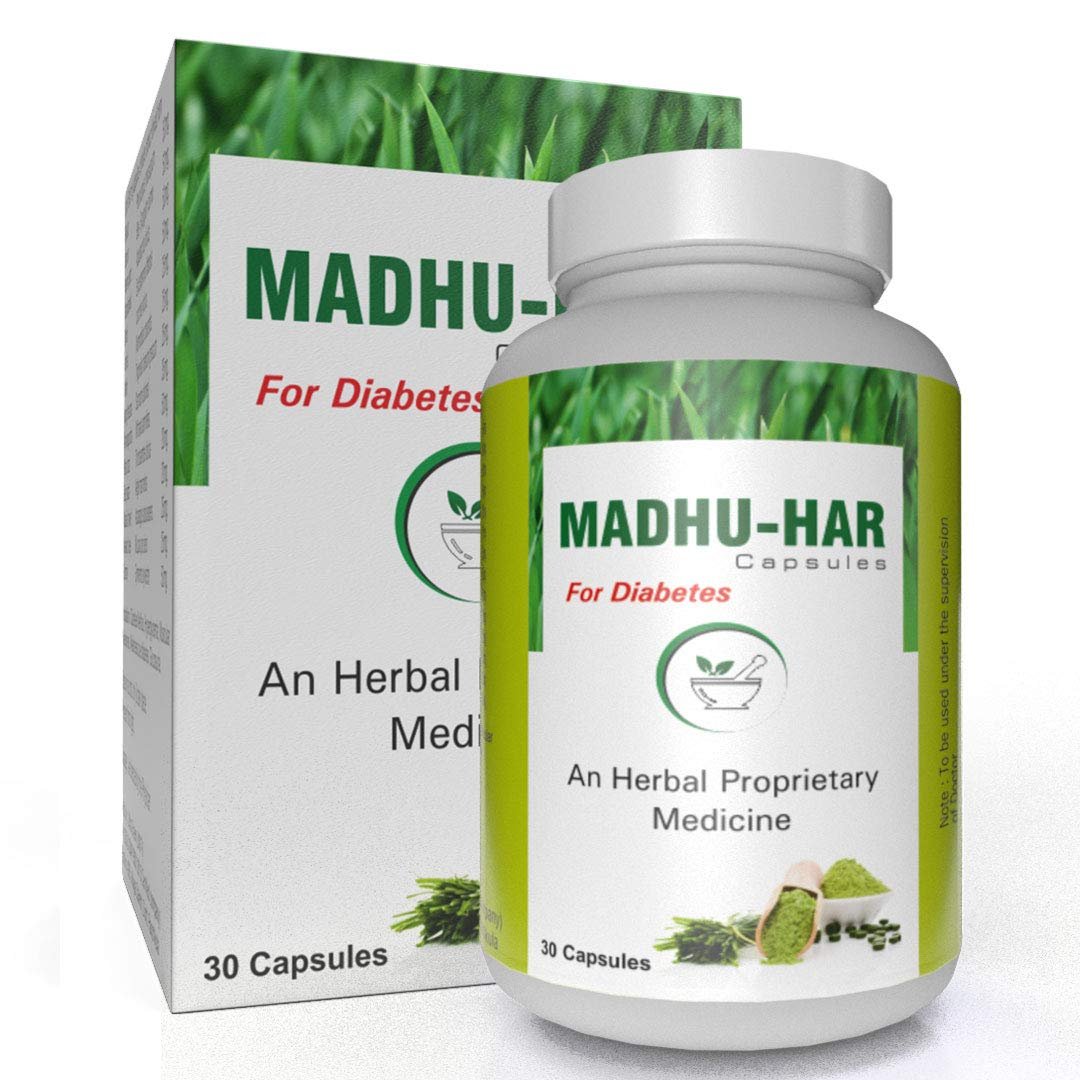 30 Caps · Capsule
10 Ayurvedic herbs — Gurmar, Ashwagandha & Methi for sustained glucose control.
Supplements, not medicines. Always consult your doctor if you are on diabetes medication or insulin before use.
Empty Stomach vs. 30 Minutes Before Meals | The Actual Difference
Empty Stomach: This distinction is almost entirely absent from competing content, and it matters.
Drinking neem karela jamun juice on a completely empty stomach – roughly 20 to 30 minutes after waking, before consuming any food – maximises the absorption of karela’s polypeptide-p and neem’s azadirachtin.
Without a competing digestive load, these compounds enter the bloodstream more efficiently and target fasting blood glucose directly.
30 Minutes Before Meals: Drinking the juice 30 minutes before a meal serves a different but complementary function.
Jamun’s alpha-glucosidase inhibitory effect is most clinically relevant immediately before a carbohydrate-containing meal, because it slows starch-to-sugar conversion in the intestine and blunts the postprandial glucose spike that follows eating.
In other words, fasting consumption targets your baseline glucose, while pre-meal consumption targets the rise after eating – and these are two distinct therapeutic goals.
For people whose primary concern is high fasting blood glucose (a common marker in Type 2 diabetes), the empty-stomach window is the priority.
For those whose blood sugar rises sharply after meals but returns to acceptable fasting levels, the pre-meal window may be more relevant.
If you’re also exploring complementary Ayurvedic support for blood sugar, learn more about formulations designed specifically for glucose management.
Chrononutrition – Why Your Body Is More Receptive in the Morning
Think of insulin sensitivity like sunlight – it is brightest and most powerful in the early hours and fades as the day progresses.
Chrononutrition research published in Diabetes Care has demonstrated that the body’s glucose-regulating systems are most active during the morning metabolic phase, when cortisol levels are higher, cellular glucose uptake is more efficient, and pancreatic insulin response is sharpest.
By evening and night, this metabolic responsiveness has declined substantially.
When you consume a glucose-modulating preparation during this morning peak, its active compounds are working with your body’s own systems, not against diminished ones.
This chrononutrition principle is not speculative – it is grounded in well-replicated circadian biology research and has been referenced in Obesity Reviews as a framework for optimising dietary and supplemental interventions for glycemic control.
The morning window is not just a cultural habit; it is physiologically justified.
The Ayurvedic Perspective on Morning Consumption
Ayurvedic practice has recommended bitter and astringent preparations in the morning for centuries – long before chrononutrition existed as a scientific concept.
The early morning period following Brahma muhurta is considered in classical Ayurveda the optimal window for cleansing and stimulating the liver, bile ducts, and pancreas.
Neem and karela are both categorised as “tikta rasa” (bitter taste) herbs, traditionally prescribed in morning rituals precisely because of their affinity for hepatic and pancreatic function.
What is striking is how closely Ayurvedic timing wisdom aligns with modern metabolic science.
The ancient reasoning centred on stimulating digestive fire (agni) in a fasted state; the modern reasoning centres on circadian insulin sensitivity. The conclusion is the same.
Two distinct frameworks, separated by centuries, point to the same window.
Recommended Morning Protocol
Wake up → Wait 20–30 minutes → Dilute 20–30ml juice in equal volume of water → Drink slowly → Wait 30 minutes → Eat breakfast
What About Drinking It at Night? A Fair Analysis
Is There Any Case for Nighttime Consumption?
A fair analysis requires acknowledging the argument before dismissing it.
The body does significant liver regeneration and cellular repair during sleep, and neem’s hepatoprotective compounds are not necessarily time-dependent in the same way its glucose-modulating effects are.
Similarly, jamun’s antioxidant activity – distinct from its alpha-glucosidase inhibitory function – does not carry the same circadian restriction.
For someone whose primary goal is liver support or general antioxidant intake, and who is not managing blood sugar or taking diabetes medication, nighttime consumption is not irrational.
It is simply less well-supported by the available evidence than morning use.
The honest answer is that nighttime use occupies a therapeutic grey zone: not harmful for the right user, but not optimal for most people’s primary health goals.
Why Night Loses to Morning for Blood Sugar Goals
For the majority of people drinking this juice – those targeting blood sugar management – nighttime consumption is poorly timed.
Insulin sensitivity is at its daily low in the evening and night hours.
Taking a glucose-modulating compound during this window is like trying to use solar power after sunset – the receiving system is not in its active phase.
Furthermore, if you drink this juice before sleep on an empty stomach with no meal following, there is no postprandial glucose spike for jamun’s alpha -glucosidase inhibition to buffer.
The compound’s most useful mechanism has no substrate to work on. You get the bitterness and the metabolic disruption without the primary therapeutic benefit.
For most blood sugar-focused users, night consumption is not dangerous – it is simply a wasted dose.
The Hypoglycemia Risk Window at Night
This is the point that no competitor article addresses, and it is clinically the most important.
For diabetic users already taking metformin, sulfonylureas (such as glipizide or glibenclamide), or insulin, consuming karela-based preparations at night creates a compounded hypoglycemia risk during sleep.
Karela’s insulin-mimetic activity adds a glucose-lowering effect on top of medication that is already working – and at night, when the user is asleep, there is no awareness of or response to blood sugar dropping below safe levels.
Nocturnal hypoglycemia in medicated diabetics is a documented clinical risk, and combining it with pharmacologically active herbal preparations without physician guidance is genuinely dangerous.
If you are on diabetes medication, nighttime consumption of this juice is not advisable without explicit medical supervision.
For support in managing stress and sleep alongside your wellness routine, read guide on adaptogen options that carry a more favourable nighttime safety profile.
Dosage, Dilution, and How Long to Take It
How Much Should You Take and How Should You Prepare It?
The typical recommended dose for commercial neem karela jamun juice is 20–30ml diluted in an equal volume of water – roughly a 1:1 ratio.
For fresh juice preparation, 15–20ml of raw bitter melon extract is the common guidance, but fresh juice is significantly more potent than commercial products and should be approached conservatively at first.
Drinking undiluted juice on an empty stomach is a reliable way to cause nausea, GI cramping, and acid reflux – especially with karela’s concentrated bitterness hitting an empty gut without any buffer.
Dilution is not optional; it is a pharmacological consideration. Drink the diluted juice immediately after preparation.
Do not let it sit for more than a few minutes, as oxidation begins to degrade the more volatile active compounds – particularly polypeptide-p – quite rapidly once exposed to air.
How Many Days Before You See Results?
Clinical expectation management is essential here, because most people abandon a useful practice because they expect faster results than the biology supports.
For fasting blood glucose improvements, bitter melon studies typically show measurable changes over 4 to 8 weeks of consistent daily use.
A review in the Journal of Ethnopharmacology noted that short-duration trials (under four weeks) showed weaker effects than longer-duration interventions, suggesting cumulative exposure matters.
Liver and digestive benefits – including improved bowel regularity, reduced bloating, and better appetite regulation – tend to be noticed sooner, often within 1 to 2 weeks.
Immunity and skin-related benefits (neem is antimicrobial and anti-inflammatory) tend to emerge in the 3 to 4-week window.
Track your fasting blood glucose weekly if that is your primary goal, rather than relying on how you feel – subjective energy changes are real but not a reliable proxy for glycemic improvement.
Who Should Not Drink It Regardless of Timing
Pregnant women should avoid this juice entirely. Neem has documented abortifacient properties in higher doses, and karela has been associated with uterine contractions in traditional medicine literature.
This is not a fringe concern – it is a consistent finding across herbal pharmacology reviews.
People with G6PD deficiency (a genetic enzyme deficiency more common in South Asian and African populations) should avoid neem, as it can trigger haemolytic anaemia in this group.
Young children should not consume this juice. People with known kidney disease should consult a physician, as high-dose karela consumption has been associated with kidney stress in isolated case reports.
Those on blood thinners, anticoagulants, or immunosuppressants should also seek medical advice before starting, as neem in particular has demonstrated enzyme-pathway interactions in pharmacological research.
These risks are explained in detail, along with full dosage guidance, in our neem karela jamun juice benefits guide.
Conclusion
The question of when to drink neem karela jamun juice does not have a single right answer – it has the right answer for your goal, your health status, and your medication profile.
Morning, on an empty stomach, 20 to 30 minutes before breakfast, is the best window for the majority of users. That timing is supported by chrononutrition science and ayurvedic tradition.
Authorship & Medical Review
Written by
Ultra Healthcare Editorial Team
Ayurvedic wellness researchers & content specialists
Our editorial team researches each guide using publicly available studies, classical Ayurvedic texts, and information shared by qualified practitioners. Every piece is reviewed before publishing, though it is written for general awareness only and is not a substitute for professional medical advice.

Reviewed by
Dr Minna Jakhar, MBBS
43+ yrs experience · M.D. Community Health & Preventive Medicine
Dr Jakhar reviewed this article for general accuracy and clarity based on her clinical background. She trained at Dayanand Medical College and has practised in community health and preventive medicine. This content is for informational purposes only and does not replace a consultation with your own doctor.
Disclaimer: This article is intended for general informational purposes only and should not be considered medical advice, diagnosis, or treatment. Always consult a qualified healthcare provider before starting any new supplement, juice, or herbal regimen, especially if you have an existing condition or take prescription medication.